Ideas on delivery
and operations.
Practical notes from live projects and daily operations, where structure, ownership and follow-through decide the outcome.

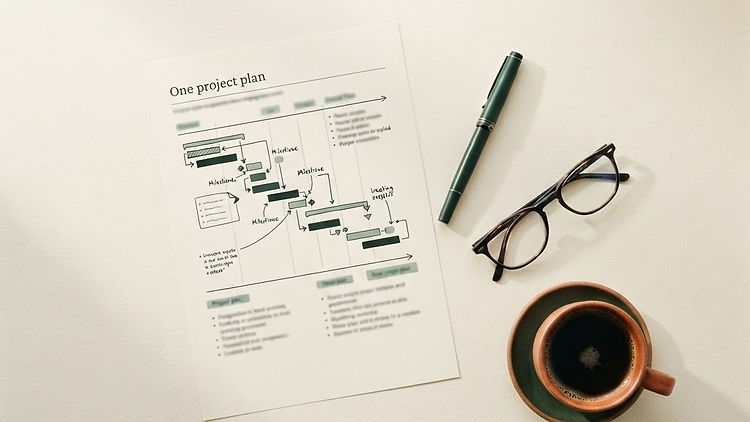
How to write a project plan people actually use
Most plans are written to get approval and then abandoned. A plan is useful when it answers the questions people ask on a Tuesday afternoon: what are we building, who decides, and what happens next.
Read article →
Structure is what makes a growing team calm
Adding process feels like adding bureaucracy. Done properly, it removes the daily negotiation about who does what.
Read article →
Rescuing a project that has fallen behind
A project is late, people are tense, and everyone has a theory about why. The first job is not to work harder. It is to replace opinion with a short, honest picture of where the work actually stands.
Read article →

Who owns what: assigning responsibility so work actually moves
Most delays are not caused by people refusing to work. They are caused by two people assuming the other one had it. Clear ownership is one of the cheapest things a business can fix.
Read article →
When a project stalls, look at the handovers
Most delays are not caused by slow work. They happen in the gaps between two teams who each believe the other owns the next step.
Read article →

The operating rhythm: making meetings earn their place
A calendar full of meetings is not a management system. A small set of recurring conversations, each with a clear purpose and output, is what actually keeps work moving.
Read article →

Turning a business idea into an operational plan
An idea only becomes a business when someone can describe how it is delivered, by whom, at what cost, and what has to be true for it to work. This is the sequence that gets you there.
Read article →

Choosing and managing vendors without losing control
Suppliers rarely fail suddenly. They fail because nobody defined what good looked like, who was watching, or how to leave. A short set of agreements prevents most of the damage.
Read article →

How to scope a project so the estimate holds
Estimates rarely miss because the arithmetic was wrong. They miss because the scope was never defined well enough to estimate. A little precision at the start is the cheapest correction available.
Read article →