How to write a project plan people actually use
Most plans are written to get approval and then abandoned. A plan is useful when it answers the questions people ask on a Tuesday afternoon: what are we building, who decides, and what happens next.
2 November 2026
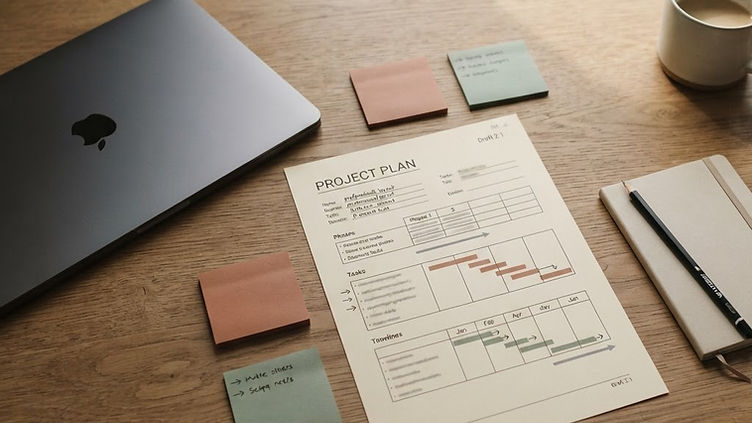
Most plans are written for the wrong audience
A project plan usually gets written once, in the opening weeks, for one purpose: to get someone to say yes. It is long, it is formatted, it has a schedule with bars on it, and it is presented in a meeting where nobody reads past page three.
Then the project starts, and the plan stops being consulted. Decisions get made in side conversations. People work from their own notes. When something slips, the plan is updated long after the fact, or not at all. Six months later it is a historical document that nobody trusts.
A plan is not a document you produce. It is a shared answer to a small set of questions. If it does not answer them, it does not matter how polished it looks.
Start from the decisions, not the template
Before writing a word, list the questions the plan has to settle. In most projects they are the same:
- What outcome are we accountable for, in language a customer or a board would recognise?
- What is definitely inside the work, and what is definitely outside it?
- Who decides when there is a disagreement?
- What has to happen before what, and where are the points of no return?
- What could realistically derail this, and what would we see first if it started to?
Five questions. A plan that answers them clearly is worth more than forty pages that answer none of them.
The five parts worth writing down
1. The outcome. One paragraph, written as a result rather than an activity. "The new ordering process is live in all three locations and staff are trained on it" is an outcome. "Implement ordering system" is a category, not a commitment. Write the outcome in the past tense, as though it has already happened, and check that everyone involved would describe success the same way.
2. The boundary. Two lists, side by side: in scope, and not in scope. The second list is the one that saves you. Every project eventually meets a request that sounds reasonable and is not part of the deal. If the exclusions are written down at the start, that conversation is a conversation about a change. If they are not, it is an argument about who is being difficult. Be specific. "Not in scope: migrating historical records before 2022; training beyond the two nominated staff per site; any work on the mobile app" tells people something. "Out of scope: other items" tells them nothing.
3. The sequence of deliverables. Not tasks, deliverables. Things that exist at the end of a piece of work and can be looked at: a signed specification, a tested process, a trained team, a live system. Break the project down to that level and you get a list you can reason about, roughly ten to forty items on a mid-sized project. For each one, note what it depends on. Dependencies are where schedules actually break, and they are invisible in a list of activities.
4. Ownership and decision rights. One name next to each deliverable, not a team name. A department cannot be accountable; a person can. Then, separately, write down the three or four decisions that will shape the project and who makes each one. Who approves a change to scope? Who signs off the design? Who can authorise additional spend, and up to what amount? Ambiguity here is the single most common cause of slow projects, and it costs nothing to resolve on paper.
5. Risks with triggers. A risk register that lists "resource constraints" and "stakeholder alignment" is decoration. A useful entry pairs a specific event with an early warning sign and a response: "If the supplier has not confirmed capacity by the end of month two, we re-plan the pilot for the following quarter rather than compressing testing." The trigger is the useful part, because it lets someone act before the problem is obvious to everyone.
Write it with the people doing the work
A plan written by one person and handed to a team is a proposal, not a commitment. The people who will do the work know where the estimate is optimistic, which dependency is fragile, and which approval takes three weeks in practice rather than two days on paper.
Run a session of ninety minutes with the people who will deliver the work. Put the outcome and the boundary on the wall. Walk through the deliverables. Ask, for each one, "what would have to be true for this to be finished on this date?" Then write down what they say, including the parts you do not like. The plan that emerges is slightly uglier than the one you would have written alone, and dramatically more likely to be followed, because the people in the room recognise their own words in it.
Keep it short and keep it alive
The plan document should fit on a few pages. The task-level detail belongs in whatever tool the team already uses, and it should be allowed to change daily without anyone rewriting the plan.
What keeps a plan alive is a short, regular review. Once a week, for thirty minutes, with the people who own the work: what finished, what is next, what is stuck, what changed. Update three things only: the status of deliverables, the risk triggers, and the forecast date if it has moved. Do not redraw the whole document. The point of the review is not reporting upwards, it is catching drift while it is still cheap to correct.
Keep a simple change log at the back: date, what changed, who approved it. It takes a minute to maintain and it ends most arguments about what was agreed.
What to leave out
Be sceptical of plan artefacts that exist to look rigorous:
- Percent complete. "Sixty per cent done" is a feeling, not a measurement, and it tends to stay at sixty per cent for a long time. Report deliverables finished against deliverables planned instead.
- Task-level Gantt charts spanning a year. They imply a precision that does not exist. Plan in detail for the next month or quarter and at deliverable level beyond that.
- Estimates with false precision. "Forty-three days" is a guess dressed as a calculation. Use ranges and say what the range depends on.
- Sections written to satisfy a template. If a section does not help anyone make a decision, cut it. Nobody will notice, and the document will be read.
Signs the plan is not working
Three quick diagnostics. First: can two people on the project describe the outcome the same way? Second: if someone asked who decides on a scope change, would the answer be immediate and identical? Third: has anything in the document changed in the last month?
If the answers are no, no, and no, the plan is a ceremony rather than a tool. That is fixable in an afternoon, and it is usually the cheapest improvement available to a struggling project.
A short checklist
- Outcome written as a result, agreed by everyone who will judge success.
- In-scope and out-of-scope lists, both specific.
- Deliverables, not activities, with dependencies noted.
- One accountable name per deliverable.
- Named decision-makers for scope, design, and money.
- Risks paired with early warning triggers and a planned response.
- A thirty-minute weekly review that updates three things.
- A change log nobody has to guess about.
A plan built this way is unglamorous. It is also the version people open when something goes wrong, which is the only test that matters.